Koto
A screenwriting tool that thinks with you.
Free to write. Pro for $15/month.
It never writes for you.
Most AI tools generate text and call it help. Koto does something different. It reads your pages, learns how you write, and helps you think through the hard parts—structure, character, tone, intent.
The words on the page are always yours.
Koto just helps you find them faster.
When you start a project, Koto has a conversation with you about your story. This becomes a set of living, editable documents that drive every brainstorm session. Koto isn’t guessing—it’s read the bible.
A subversive action comedy mini-series set in San Gabriel Valley. When ICE agents terrorize the Chinese community, there is only one team that can stop them: a gang of militant, vigilante crime fighting grannies known as the Joy Glock Club. The comedy lives in the gap between extreme violence and extreme domesticity. Leone meets Shaw Brothers meets grandma comedy.
The central question: Can four grandmothers save a neighborhood that will never know it needed saving — or who saved it?
72. Retired seamstress. Still makes her own clothes. Speaks four languages, claims two. Her kung fu is classical — economical, invisible until it isn’t. The kind of woman who has already solved the problem before you’ve finished explaining it. Authority comes from being right so often she stopped needing to say so. Has protected this community for thirty years under the cover of being harmless. Finds it mildly insulting that it keeps working.
68. Former restaurant owner. Sold the restaurant. Did not stop being angry. Hits first, asks nothing. The others consider her a liability; she considers herself a time-saver. Surprisingly gentle with children and dogs. Everyone else should watch themselves.
74. Offers food before, during, and after violence. It is unclear if this is hospitality or psychological warfare. Possibly unclear to Peggy too. Deadpan so complete it reads as cognitive — it is not. The most dangerous person in any room, including rooms Helen is in. Helen knows this.
49. The young one. Came in as ICE. Didn’t leave that way. Spent six months running surveillance on the group and developed what she describes as professional respect and what the others describe as getting got. Still carries the badge Helen made. Hasn’t decided if that’s embarrassing or clarifying.
Spaghetti western comedy. The visual grammar borrows from Leone — wide establishing shots, slow push-ins, eyes in close-up before violence. The pacing borrows from Shaw Brothers — sudden tonal shifts from comedy to action with no transition.
References: Kill Bill (tonal whiplash), Better Call Saul (slow burn domestic tension), Raising Arizona (crime-family absurdism).
San Gabriel Valley, present day. Pearl River Bakery -- a non descript bakery serving fresh egg tarts at 530am for the past 30 years -- is the ladies main lair. Think Bond hideout with immaculate feng shui. Here they gather to monitor ICE movements, discover new ways to use cleavers, and play mahjong.
Other key locations: 99 Ranch parking lot, the church kitchen, San Gabriel courthouse.
Comedy and danger are inseparable. One always lives inside the other.
The grandmas never acknowledge how extraordinary they are.
Treat violence as mundane, snacks as urgent.
Think in zoom punches, smash cuts, Leone geometry.
Dialogue should feel clipped and naturalistic. Characters talk past each other. No one says what they mean — subtext carries the weight.
Violence is stylized but consequences are real. A fight scene should feel choreographed. A funeral scene should feel earned.
Episodes are 1-2 minutes. Every word counts.
Act and episode endings must create forward pull – unresolved tension, a revelation, or a question the audience can’t sit with.
Consistently short — 1–3 lines per speech. Parentheticals almost never used. Characters deflect rather than confront. Humor is dry, punchlines land through understatement. High confidence.
Sparse and visual. Describes what the camera sees, not internal states. Short paragraphs, active verbs. High confidence.
- Avoids flashbacks as a structural device
- No characters stating emotions directly in dialogue
- Rejects tidy resolutions — prefers ambiguity
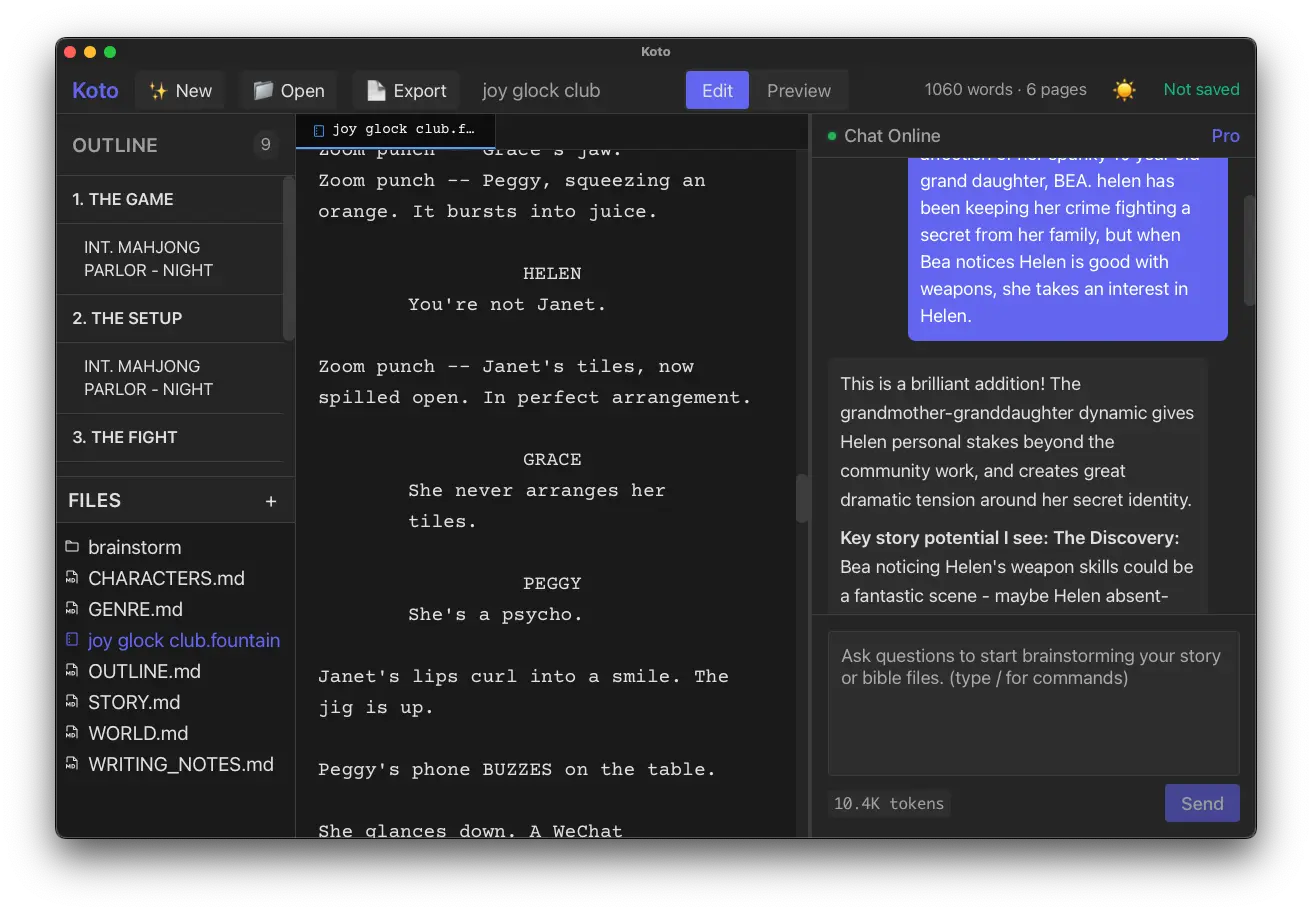
As you write, Koto builds your voice profile—observations about your patterns, your tendencies, your style. Offbeat protagonists or conventional heroes? Sparse action lines or dense? Hard cuts or slow dissolves?
You can read it, edit it, shape it. It’s not a black box. It’s a mirror.
Scenes tend to end abruptly, often mid-dialogue. Action lines are visual and sparse — describes what the camera sees, not internal states. Dialogue runs short. Characters deflect rather than confront directly. Tone balances dry humor with genuine vulnerability.
When a suggestion doesn’t fit your project, Koto notices. Over time it stops reaching for the obvious and pushes toward the specific—the choices only you would make.
Every writer gets stuck. You know the feeling—staring at a scene that isn’t working, knowing something’s off but not what. Koto can help.
The second act break isn’t landing. Maya’s decision to leave feels unmotivated.
Right now Maya’s choice comes out of nowhere because the audience hasn’t seen what staying costs her. What if we’ve already seen a scene where she sacrifices something to keep the peace—and the audience is tracking that resentment before she is?
/stuck — What’s not working in this scene?
Give me 20 specific external goals for Mandy in this pilot.
1. Get her mother's signature on the DNR 2. Return the borrowed truck before Gio notices 3. Make the 4pm court filing deadline 4. Hide the bruise before the school pickup 5. Convince the landlord the dog is a "service animal" ...
Explore character—specific, not generic.
/audience
At this point the audience knows:
— The letter exists (shown in scene 3)
— Maya hasn’t read it (she was interrupted)
— Ray knows what’s in it (his reaction, scene 5)
Active questions the audience is holding:
— Will Maya find the letter?
— Does Ray know she hasn’t read it?
— What was in the envelope Gio pocketed?
/audience — Track dramatic irony across your script.
/wants
In this scene:
— Maya wants to get through dinner without a confrontation
— Ray wants Maya to acknowledge what happened
— Gio wants to leave before either of them notices what he took
The friction: Maya and Ray are avoiding the same conversation from opposite sides, while Gio is running a clock nobody else knows about.
/wants — What does each character want here?
/stuckWhat’s not working in this scene?/toneWhat tone is this scene hitting?/wantsWhat does each character want here?/audienceWhat does the audience know at this point?Everything else, just ask.
Write in plain text. Scene headings, dialogue, transitions—formatted as you type. What you see is what you export.
Industry-standard screenplay PDF. Courier 12pt, proper margins, correct page breaks. The script your agent expects.
Your scripts live in folders on your machine. No cloud, no databases, no lock-in. Your project is a directory.
The Sumi palette was designed for long writing sessions. Warm paper tones on dark backgrounds. Low eye strain, high focus.
Plain text files. Version control, branching, diffs—they all just work. Never lose a draft.
We know the conversation around AI and writing. We’re writers too, and we take it seriously.
Koto is local-first. Your files live in folders you control. There is no cloud sync, no server holding your work.
Not ours. Not anyone else’s. Your scripts are yours.
Everything Koto learns about your writing is stored as a readable document in your project folder. No black box. No hidden data. Open it in any text editor.
A micro-series. Leone meets Shaw Brothers meets grandma comedy.
We wrote this with Koto. Every word.
Mystical powers that dwell within words and names, allowing spoken sounds to manifest reality...
Fountain—an open, plain-text screenplay format. Your scripts are .fountain files you can open in any text editor. No lock-in, no proprietary formats.
Yes. Everything except the chat works without an internet connection. Your scripts live on your machine—you can write anywhere.
No. Koto is a thinking tool. It helps you work through story problems, explore characters, and find your way into a scene. The writing is yours.
Never. Your scripts stay on your machine. They are never sent to any server for training purposes.
Koto is a different approach. If you love your current tool, keep using it. Koto is for writers who want a fast screenwriting editor with a brainstorming chat built in—and who care about owning their files as plain text.
Yes. Your scripts are local files—they don’t disappear if you cancel. You can always use the free tier to edit and export.
Mac-only at launch. Other platforms are on the roadmap.