Story — Joy Glock Club
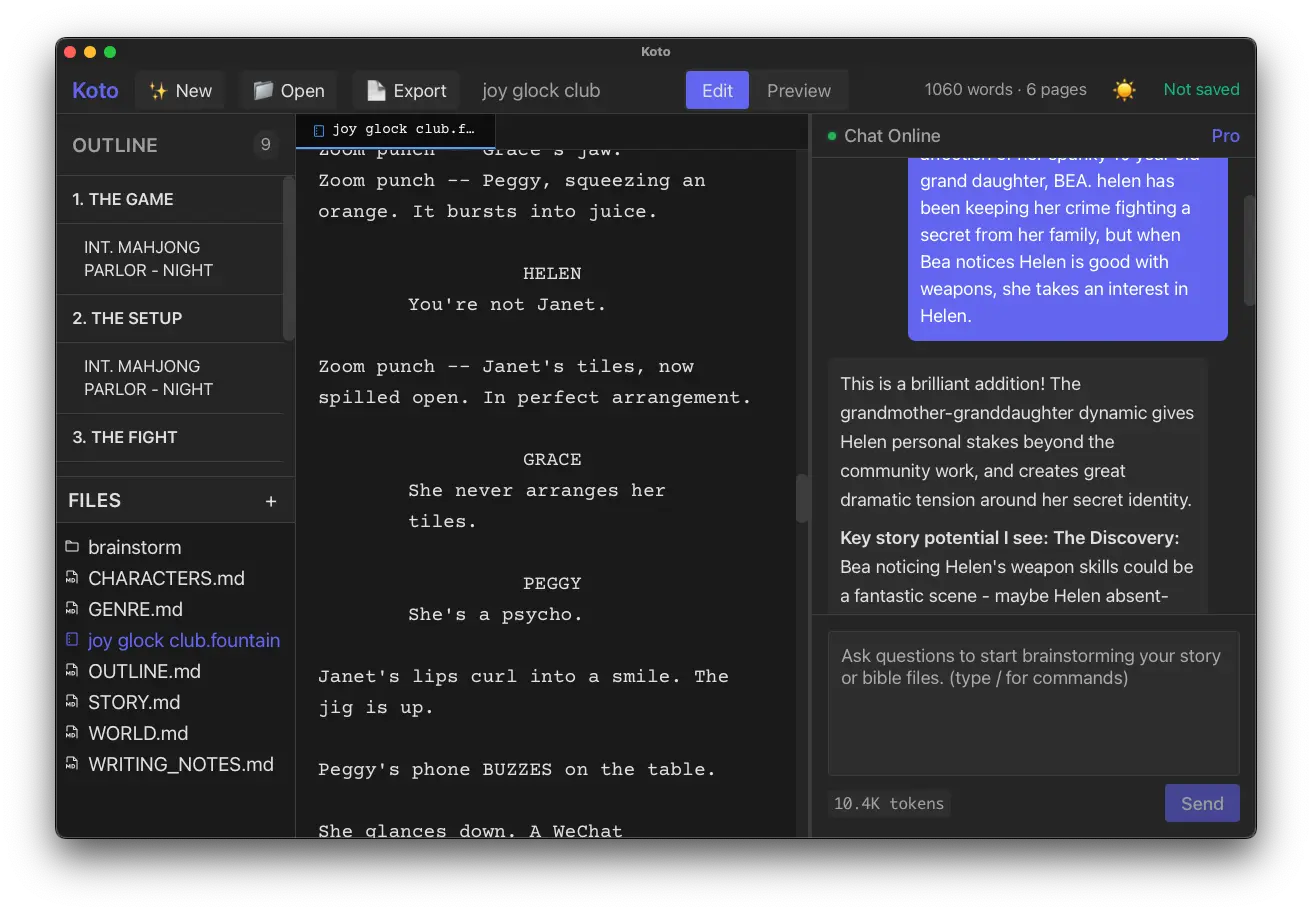
A subversive action comedy half hour TV show set in San Gabriel Valley. When ICE agents terrorize the Chinese community, there is only one team that can stop them: a gang of militant, vigilante crime fighting grannies known as the Joy Glock Club. The comedy lives in the gap between extreme violence and extreme domesticity. Leone meets Shaw Brothers meets grandma comedy.
The central question: Can four grandmothers save a neighborhood that will never know it needed saving — or who saved it?
Characters — Joy Glock Club
HELEN.
72. Retired seamstress. Still makes her own clothes. Speaks four languages, claims two. Her kung fu is classical — economical, invisible until it isn’t. The kind of woman who has already solved the problem before you’ve finished explaining it. Authority comes from being right so often she stopped needing to say so. Has protected this community for thirty years under the cover of being harmless. Finds it mildly insulting that it keeps working.
GRACE.
68. Former restaurant owner. Sold the restaurant. Did not stop being angry. Hits first, asks nothing. The others consider her a liability; she considers herself a time-saver. Surprisingly gentle with children and dogs. Everyone else should watch themselves.
PEGGY.
74. Offers food before, during, and after violence. It is unclear if this is hospitality or psychological warfare. Possibly unclear to Peggy too. Deadpan so complete it reads as cognitive — it is not. The most dangerous person in any room, including rooms Helen is in. Helen knows this.
JANET.
49. The young one. Came in as ICE. Didn’t leave that way. Spent six months running surveillance on the group and developed what she describes as professional respect and what the others describe as getting got. Still carries the badge Helen made. Hasn’t decided if that’s embarrassing or clarifying.
Genre — Joy Glock Club
Spaghetti western comedy. The visual grammar borrows from Leone — wide establishing shots, slow push-ins, eyes in close-up before violence. The pacing borrows from Shaw Brothers — sudden tonal shifts from comedy to action with no transition.
References: Kill Bill (tonal whiplash), Barry (the mundane and ordinary are lethally competent), Nobody (competence mistaken for invisbility).
World — Joy Glock Club
San Gabriel Valley, present day. Pearl River Bakery -- a non descript bakery serving fresh egg tarts at 530am for the past 30 years -- is the ladies main lair. Think Bond hideout with immaculate feng shui. Here they gather to monitor ICE movements, discover new ways to use cleavers, and play mahjong.
Other key locations: 99 Ranch parking lot, the church kitchen, San Gabriel courthouse.
Writing Notes — Joy Glock Club
Comedy and danger are inseparable. One always lives inside the other.
The grandmas never acknowledge how extraordinary they are.
Treat violence as mundane, snacks as urgent.
Think in zoom punches, smash cuts, Leone geometry.
Dialogue should feel clipped and naturalistic. Characters talk past each other. No one says what they mean — subtext carries the weight.
Violence is stylized but consequences are real. A fight scene should feel choreographed. A funeral scene should feel earned.
Voice Profile — Joy Glock Club
Structure
Episodes are 25-30 pages with an act break every 10 pages.
Act and episode endings must create forward pull – unresolved tension, a revelation, or a question the audience can’t sit with.
Dialogue
Consistently short — 1–3 lines per speech. Parentheticals almost never used. Characters deflect rather than confront. Humor is dry, punchlines land through understatement. High confidence.
Action Lines
Sparse and visual. Describes what the camera sees, not internal states. Short paragraphs, active verbs. High confidence.
Preferences
- Avoids flashbacks as a structural device
- No characters stating emotions directly in dialogue
- Rejects tidy resolutions — prefers ambiguity